.png)
Nature Metric of the Month: Critical Areas for Biodiversity and Nature’s Contributions to People (NCPs)

In this month's Nature Metric of the Month, we take a close look at Neugarten et al. (2024) Critical Areas for Biodiversity and NCP’s metric, designed to help you prioritise where management activities will help maximise ecosystem service provision.
What are the Critical Areas for Biodiversity and Nature Contribution to People Metric?
The Critical Areas for Biodiversity and NCPs metric, is designed to identify asset locations in areas that, if sustainably managed, can provide:
- 90% of the current levels of ten key Nature’s Contributions to People (NCPs), and
- Achieve minimum representation targets for 26,709 terrestrial vertebrate species.
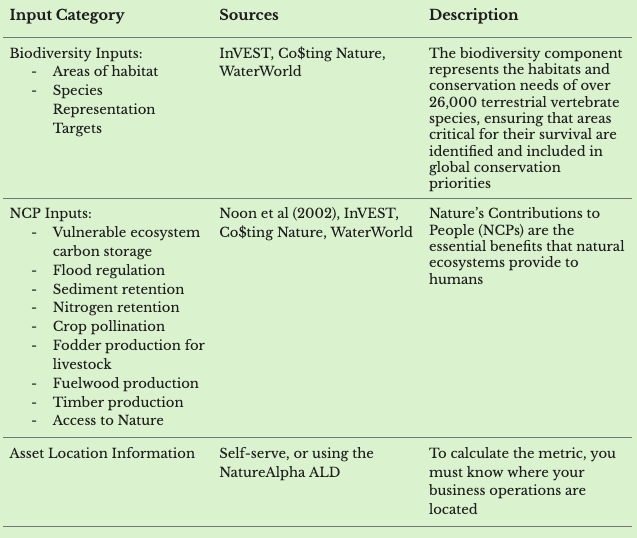
This is achieved through a global spatial optimisation at 10 km resolution. The metric integrates NCP provisioning, biodiversity distributions, and representation targets into one prioritisation framework. It therefore can be used as a decision-support tool for financial institutions and corporates seeking to align conservation, mitigation, and restoration goals. The metric is similar in purpose to STAR (Species Threat Abatement and Restoration), which also identifies priority areas for maximising conservation impact. However, here the focus is broadened to include not only species extinction risk but also the areas that sustain critical ecosystem services.
Inputs to the Metric
Why Use This Metric?
- Integrated Conservation Planning: Combines biodiversity and ecosystem service priorities into a single spatial framework, supporting aligned decision-making.
- Supports Global Targets: Directly informs implementation of the Kunming-Montreal Global Biodiversity Framework (30x30) by identifying where conservation is most impactful.
- Identifies Synergies and Conflicts: Highlights where biodiversity and NCPs overlap with high development potential (e.g., agriculture, renewables, mining).
More than one-third of priority areas overlap with high development pressure. - Provides Guidance for Conservation Investment: Enables efficient allocation of capital to areas with the highest combined benefits.
- Aligns With Corporate and Investment Decision-Making: Like how STAR helps institutions prioritise species threat abatement, this metric helps identify landscapes essential for sustaining ecosystem services.
Limitations
- Incomplete biodiversity representation: Excludes plants, invertebrates, marine and freshwater biodiversity.
- Global-scale modelling may mask local variation: Finer-scale planning is required for implementation. Hence good for larger scale investment prioritisation
- NCP data limitations: Some NCPs are underestimated, especially in sparsely vegetated or highly modified landscapes.
- Not intended to prescribe strict protection: Some priority areas depend on sustainable use, not exclusion of human activity. More could be done to define these areas.
Application of the Metric
- Corporate and Financial Sector Risk Assessment: Like STAR’s value for mitigation prioritisation, this metric can help identify:
- Nature-related risks, through identifying sites that could impact local ecosystem service provision (posing transition risks)
- Impacts of operations, through change over time in NCP provision
- Evaluating Land-Use Trade-Offs: Identifies where renewable energy, agriculture, mining, or urban expansion may conflict with conservation objectives and/or reduce ecosystem services to the detriment of the existing operations
- Supporting ESG Strategy and Screening: Helps investors identify companies operating in globally significant landscapes, informing engagement strategies.









.jpg)
.jpg)