.png)
The Nature Data Revolution: How AI Is Transforming Our Understanding of Biodiversity Risk

Dr. Jasper Hajonides, Head of AI & Data Science at NatureAlpha
For years, investors could reasonably argue that nature risk was too complex, too local and too poorly measured to integrate into mainstream financial decision-making. That argument is becoming harder to sustain. Advances in AI and data science are rapidly changing what can be measured, monitored and understood about companies' relationships with nature.
Why Nature Data is Changing
The rapid evolution of data science, particularly driven by AI, is reshaping what is possible for nature data. Tasks that were manual, slow and difficult to scale only a few years ago can increasingly be automated: identifying relevant company documents, extracting environmental disclosures, linking business activities to locations, and connecting those locations to ecosystem sensitivity and degradation.
To put this in perspective, a common challenge five years ago was writing code to identify a specific datapoint — for example water use, land use, sourcing information or the location of an operating asset — from a manually downloaded company report. Today, automated pipelines can identify relevant documents, extract those disclosures and combine them with geospatial and ecological datasets within seconds.
The result is an explosion in the availability and granularity of nature-related data. This matters because biodiversity loss and ecosystem degradation are no longer abstract concerns: they can translate into operational disruption, changing regulation, reputational exposure, supply-chain vulnerability and physical risks linked to specific locations.
For investors and financial institutions, understanding these dynamics is becoming critical for capital allocation, risk management, and long-term value creation.
The challenge: turning data into decisions
Data availability alone, however, is not enough. A company's relationship with biodiversity is inherently multidimensional: shaped by its operations, the pressures it exerts on ecosystems, how it manages those exposures, where it operates, and the risks associated with those locations. The challenge lies in integration — combining diverse data streams into a coherent, decision-relevant picture.
Different financial stakeholders also need nature data in different forms. Portfolio managers may need to screen exposures across thousands of holdings. Analysts may need to drill into the activity, location and pressure pathways that explain why a company appears high risk. Stewardship teams may need evidence to identify the right questions to actively engage with management.
This need for decision-useful data is also reflected in the direction of global policy and disclosure frameworks. The Kunming-Montreal Global Biodiversity Framework, the Taskforce on Nature-related Financial Disclosures and the work of IPBES all point in the same direction - companies and investors are increasingly expected to identify, assess and respond to nature-related impacts, dependencies, risks and opportunities.
Waiting for perfection delays action
The IPBES Business & Biodiversity Assessment, released in February 2026, reinforced an important point: nature data does not need to be perfect before it can support better business and investment decisions. What needs to be measured will vary by company, sector, location and use case, and methods for assessing impacts are currently more mature than those for dependencies. But credible methodologies already exist and are being applied across different contexts.
In practice, this means waiting for a universally accepted "CO2-equivalent" metric for nature is the wrong approach. Nature is too complex, location-specific and multidimensional to be reduced to one perfect number. The absence of perfection should not become a reason for inaction.
Building a comprehensive picture
Nature risk cannot be captured by a single datapoint. But that does not mean it has to be too complex to use. The key is to organise nature-related information around a set of core dimensions, including where companies operate, how they impact and depend on nature, and what policies or management responses they have in place.
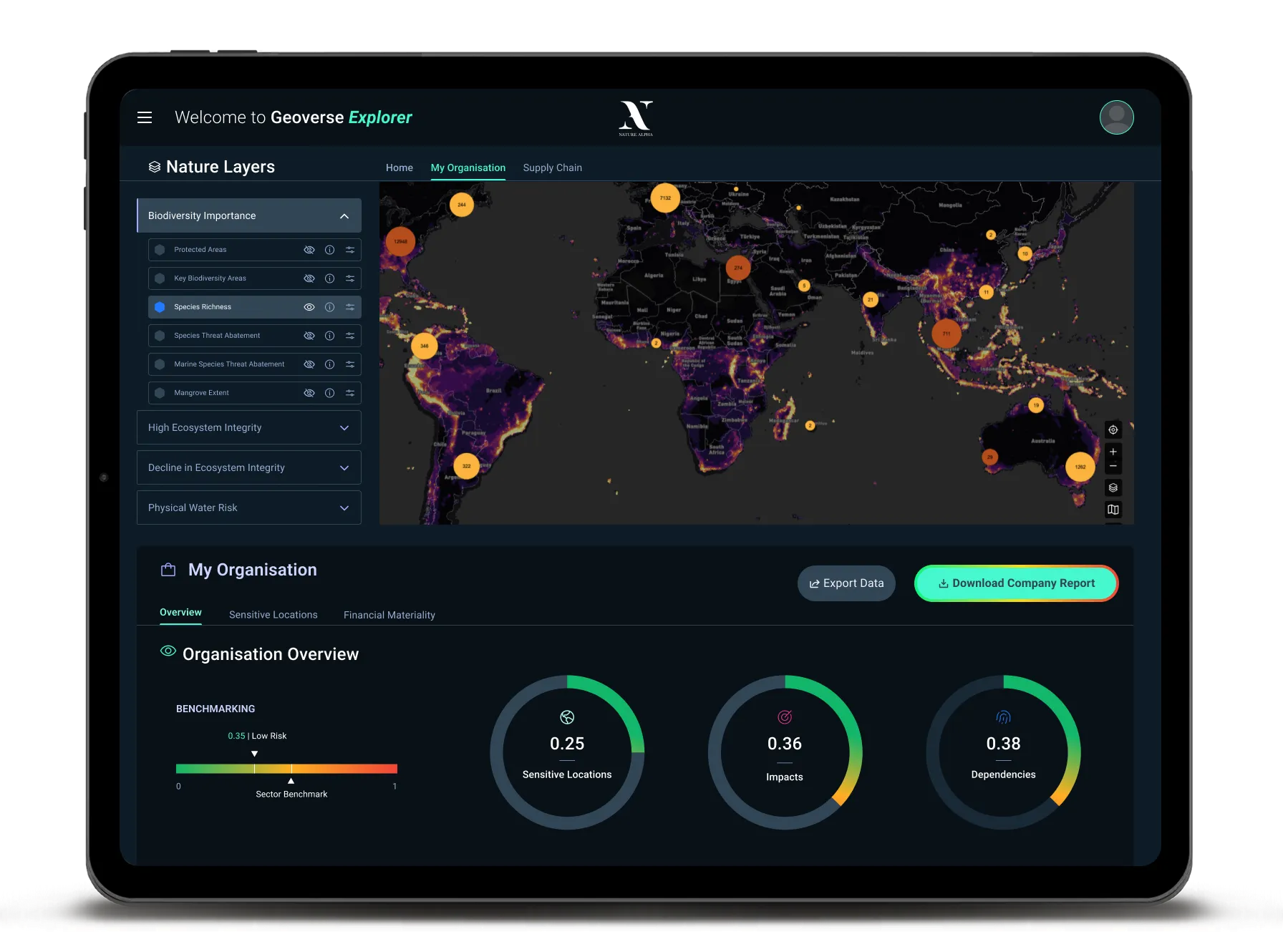
This is the logic behind NatureAlpha's approach. We structure biodiversity risk hierarchically, so users can start with top-level indicators or an overall nature risk score, scaled from 0 to 1, and then drill down into the underlying drivers where needed. Those drivers may include business activities, environmental pressures, asset locations, ecosystem sensitivity, management practices and forward-looking site-level risk.
In practice, this allows investors to move between portfolio-level screening and company-level analysis without treating nature as either impossibly complex or over-simplified. The aim is not to reduce nature to a single number, but to make multiple dimensions of nature risk usable for decision-making.
Looking ahead
The big question is what this space will look like in five to ten years. The rapid advancement of AI means nature data granularity today would have been unimaginable five years ago — and this progress will continue in the coming years.
As the data evolves, the priority will be ensuring that financial stakeholders have the tools needed to integrate nature meaningfully into decision-making. The revolution in nature data is already visible in many processes. The question now is whether financial markets will keep pace.








.jpg)
.jpg)